How Artificial Intelligence and Machine Learning Are Changing the World
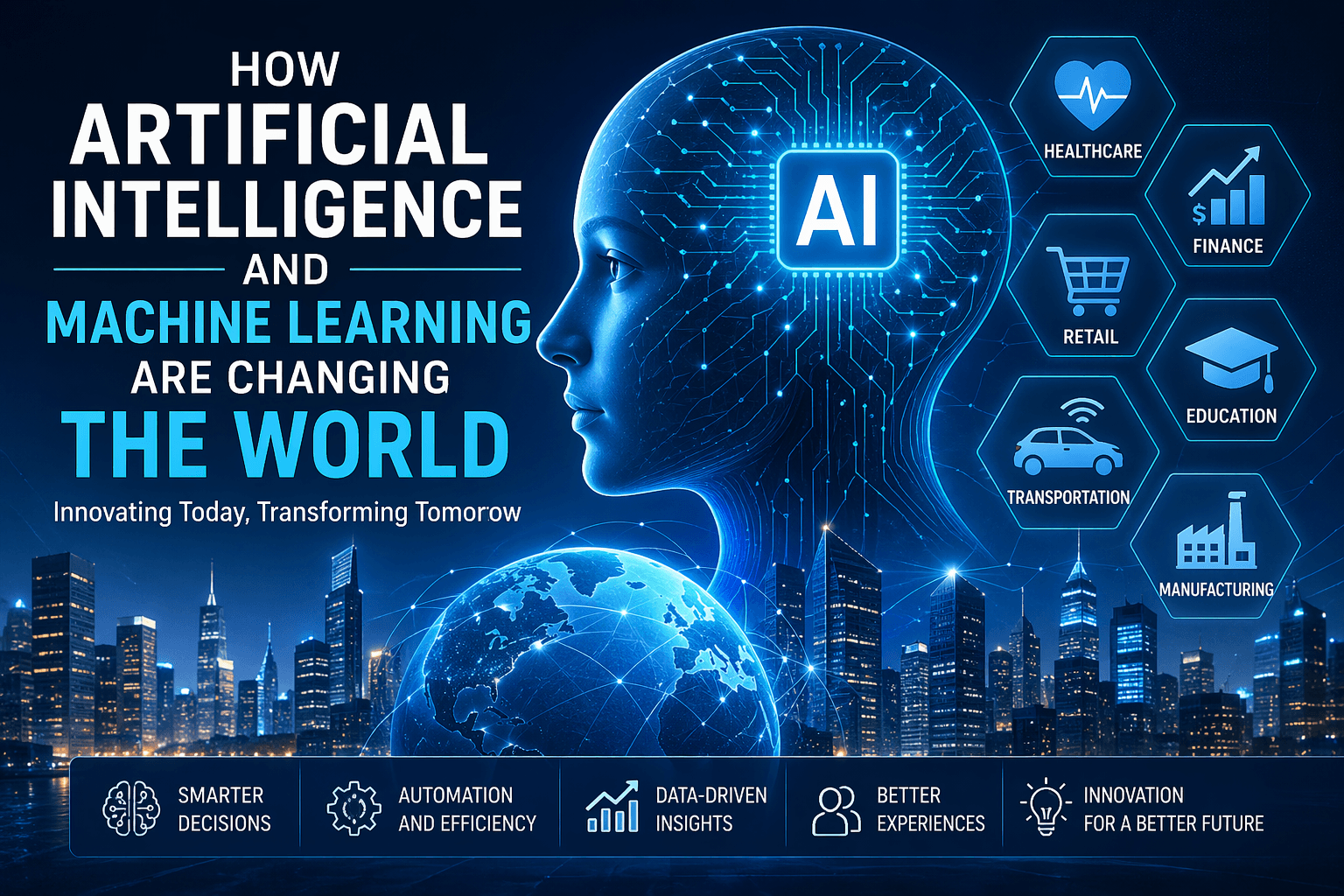
How Artificial Intelligence (AI) and Machine Learning Are Changing the World in 2026
Introduction
Artificial Intelligence (AI) and Machine Learning (ML) are no longer futuristic concepts—they are powerful technologies shaping the modern world. From voice assistants and recommendation systems to autonomous vehicles and advanced healthcare diagnostics, AI and ML are transforming industries and redefining how humans interact with technology.
In 2026, the influence of AI continues to grow rapidly, enabling smarter decision-making, improving efficiency, and unlocking new opportunities across every sector. This article explores how AI and ML work, their real-world applications, benefits, challenges, and what the future holds.
What is Artificial Intelligence (AI)?
Artificial Intelligence refers to the development of computer systems capable of performing tasks that typically require human intelligence. These include reasoning, learning, problem-solving, perception, and language understanding.
AI systems are designed to process large amounts of data, recognize patterns, and make decisions with minimal human intervention.
Types of AI
-
Narrow AI (Weak AI):
Designed to perform a specific task, such as facial recognition or voice assistants like Siri and Alexa. -
General AI (Strong AI):
A theoretical concept where machines can think, learn, and perform any intellectual task that a human can do.
What is Machine Learning (ML)?
Machine Learning is a subset of AI that focuses on enabling machines to learn from data rather than being explicitly programmed. ML algorithms analyze data, identify patterns, and improve their performance over time.
Types of Machine Learning
1. Supervised Learning
Uses labeled data to train models.
Example: Email spam detection.
2. Unsupervised Learning
Finds hidden patterns in unlabeled data.
Example: Customer segmentation.
3. Reinforcement Learning
Learns through rewards and penalties.
Example: Game-playing AI or robotics.
AI vs Machine Learning: Key Differences
While closely related, AI and ML have distinct roles:
- Artificial Intelligence is the broader concept of machines simulating human intelligence.
- Machine Learning is a subset of AI focused specifically on learning from data.
In simple terms, AI is the goal, and ML is one of the primary methods used to achieve that goal.
Real-World Applications of AI and ML
AI and ML are already embedded in many aspects of daily life. Here are some of the most impactful applications:
1. Healthcare
AI is revolutionizing healthcare by improving diagnosis accuracy and treatment efficiency.
- Early disease detection (e.g., cancer screening)
- Medical image analysis
- Drug discovery and development
- Personalized treatment plans
2. Finance
Financial institutions use AI to enhance security and optimize operations.
- Fraud detection and prevention
- Credit scoring and risk analysis
- Algorithmic trading
- Customer service automation
3. E-commerce and Retail
AI improves customer experience and business performance.
- Personalized product recommendations
- Chatbots for 24/7 support
- Inventory and demand forecasting
- Dynamic pricing strategies
4. Transportation
AI is transforming mobility and logistics.
- Self-driving vehicles
- Traffic and route optimization
- Predictive maintenance in vehicles
- Smart logistics systems
5. Education
AI is making learning more accessible and personalized.
- Adaptive learning platforms
- AI tutors and virtual assistants
- Automated grading systems
- Content recommendations for students
6. Entertainment and Media
- Streaming recommendations (Netflix, YouTube)
- AI-generated content
- Video and image recognition
- Gaming AI improvements
Benefits of AI and Machine Learning
Increased Efficiency
AI automates repetitive and time-consuming tasks, allowing humans to focus on more strategic work.
Data-Driven Decision Making
Organizations can make better decisions based on insights derived from large datasets.
Cost Reduction
Automation reduces operational costs and improves productivity.
Improved Accuracy
AI systems can analyze data with high precision, reducing human error.
Enhanced User Experience
Personalization leads to better customer satisfaction and engagement.
Challenges and Risks of AI and ML
Despite their benefits, AI and ML come with important challenges:
Data Privacy Concerns
Large amounts of personal data are required, raising security and privacy issues.
Algorithmic Bias
AI systems can inherit biases from training data, leading to unfair outcomes.
Job Displacement
Automation may replace certain jobs, requiring workforce adaptation.
Lack of Transparency
Some AI models operate as “black boxes,” making decisions difficult to explain.
Emerging Trends in AI and ML (2026 and Beyond)
Generative AI
AI systems capable of creating content such as text, images, music, and code.
AI in Cybersecurity
Advanced threat detection and automated responses to cyber attacks.
Edge AI
Processing data locally on devices instead of relying on cloud systems.
AI + IoT (Smart Cities)
Connected systems improving urban infrastructure, energy use, and traffic management.
Natural Language Processing (NLP)
More human-like interactions between machines and users.
The Future of AI and Machine Learning
The future of AI and ML is incredibly promising. As technology advances, we can expect:
- More intelligent automation across industries
- Improved human-AI collaboration
- Breakthroughs in healthcare and science
- Ethical AI development frameworks
- Increased accessibility of AI tools
AI will not replace humans but will augment human capabilities, leading to a more efficient and innovative world.
Conclusion
Artificial Intelligence and Machine Learning are transforming the world in ways we could only imagine a decade ago. From improving healthcare outcomes to enhancing everyday digital experiences, these technologies are at the core of modern innovation.
However, with great power comes great responsibility. Ensuring ethical use, transparency, and fairness will be critical as AI continues to evolve.
Frequently Asked Questions (FAQ)
What is the difference between AI and Machine Learning?
AI is the broader concept of machines simulating human intelligence, while ML is a subset that enables machines to learn from data.
Is AI replacing human jobs?
AI is automating certain tasks, but it is also creating new job opportunities in technology and data-driven fields.
Why is AI important?
AI improves efficiency, enables better decision-making, and drives innovation across industries.
Call to Action
If you found this article helpful, share it with others and stay updated with the latest trends in AI and Machine Learning by following our blog.
Found this useful?
Share it with your network